A few months ago I was in Bangkok pitching hotels on a QR food-ordering app. It didn't go well. Hotels didn't want it, guests already had GrabFood, and I killed the idea on the spot — which is a polite way of saying I went back to the drawing board with nothing.
So I did what any reasonable person does after a product dies: I went back to Bangkok and started asking hotel managers what was actually annoying them. Not what I thought they needed. What was actually annoying them.
One manager, at a hotel called Sleep Withinn, gave me the most honest answer of the trip. I asked about guest communication and he just sighed and said: "Same same same. We get the same questions every day." Availability. Rates. Check-in times. All day, every day, by email.
He said it like it was just the cost of doing business. A mild, permanent headache.
But it got me thinking about the other side of that inbox. If the front desk is this tired of answering the questions they do see — what's happening to the ones they don't?
So I ran an experiment to find out.
I wasn't trying to catch hotels out or rank them. I simply wanted to understand what the direct booking experience looked like from the guest's perspective.
Methodology
I sent the same booking inquiry to 39 independent hotels across Bangkok — Sukhumvit, Silom, and Khao San. Same dates, same simple question, same intent to book directly instead of through an OTA. No tricks, no traps. Just a normal traveler asking: do you have a room, and what's the rate?
Some inquiries went by email. Some through LINE. I tracked every response — whether it came, how fast, and what it actually said.
Results
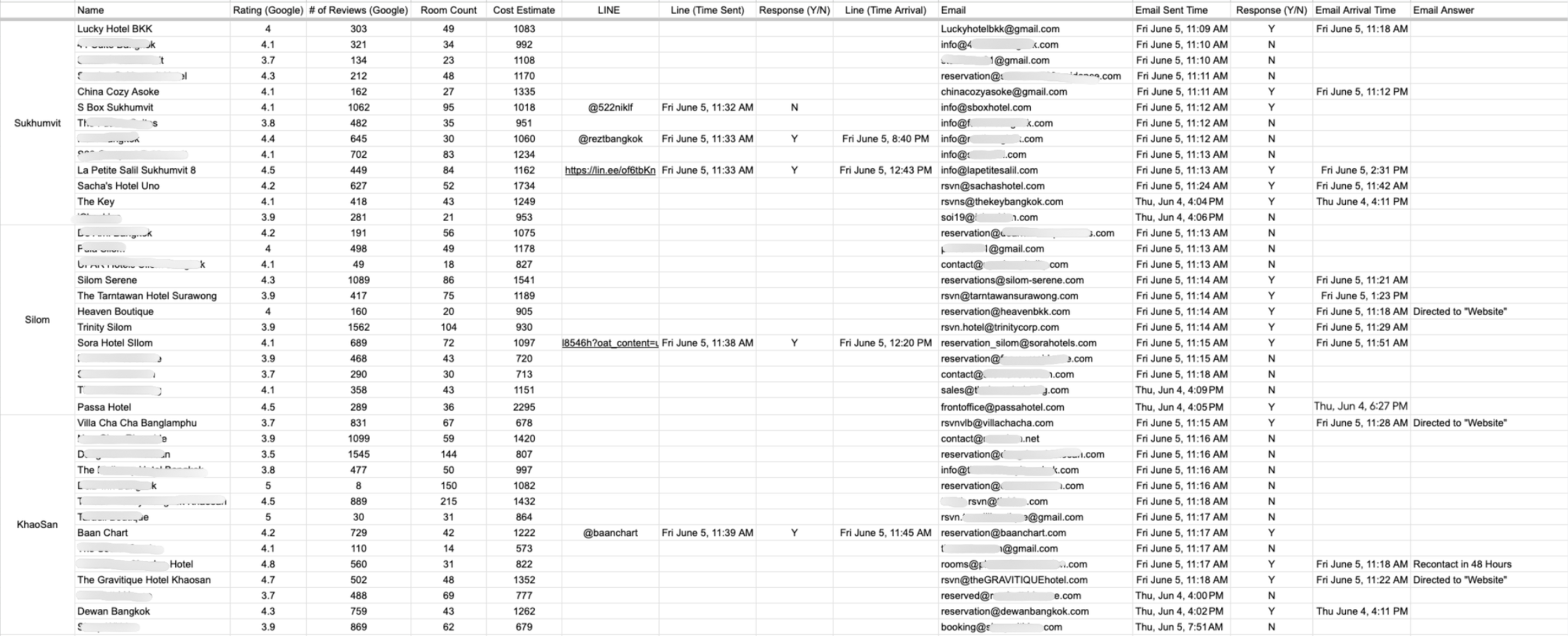
24 out of 39 hotels never responded. That's 62%.
Of the 15 that did respond, only 11 gave an answer that could actually lead to a booking. Three redirected me to a website without giving an actual rate — which, if you're a traveler with five other tabs open, is basically the same as not responding. And one hotel's auto-reply promised a response "within 48 hours" — then actually replied five days later.
Outcome
Count
%
No response
24
62%
Responded with usable rate
11
28%
Redirected to website (no rate given)
3
8%
Promised 48 hours, replied in 5 days
1
2%
Total contacted
39
100%
The actual tracking sheet. Names blurred for hotels that never responded.
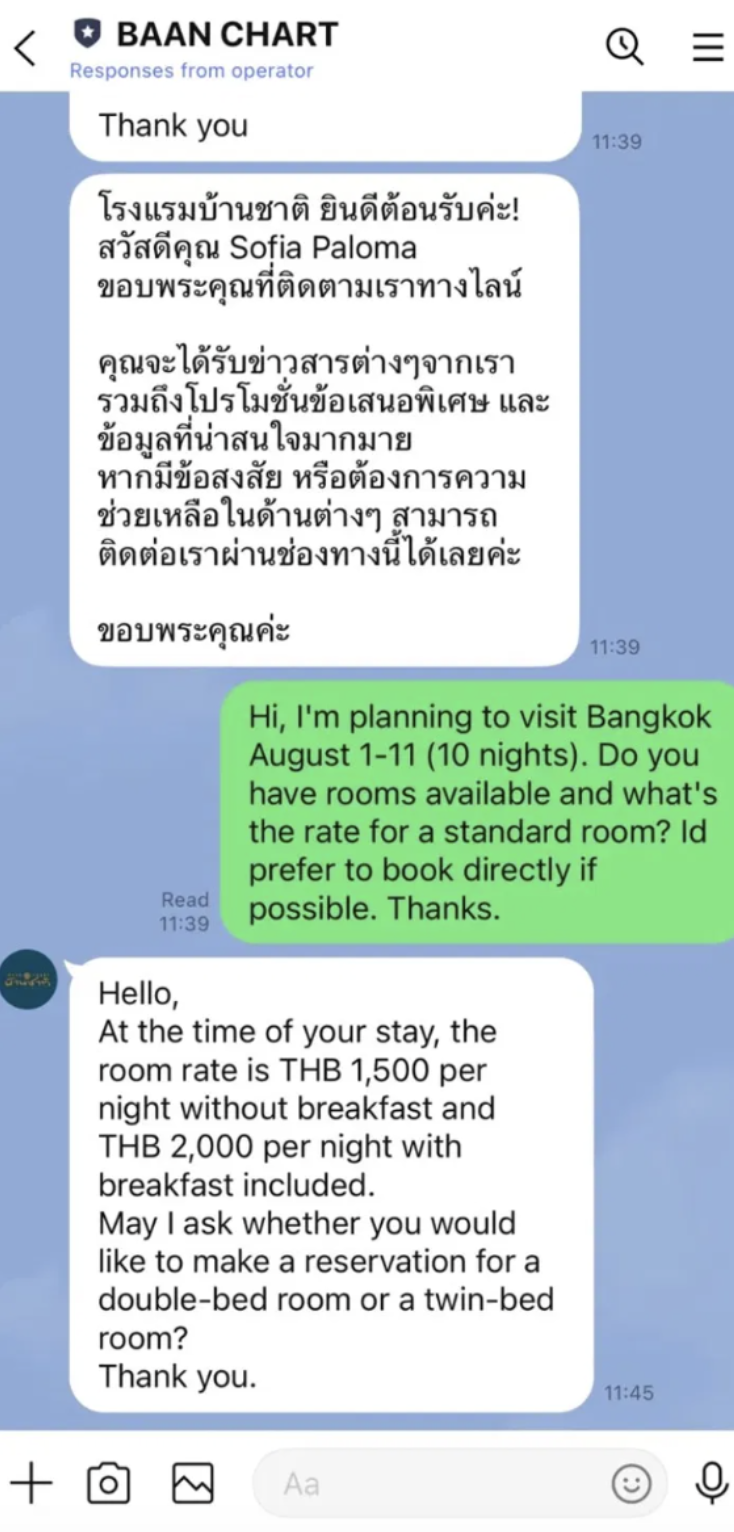
The fastest response came in 6 minutes, on LINE, complete with a rate and a follow-up question. The slowest usable response came almost 12 hours later — polite, complete, and far too late to matter to anyone planning a trip.
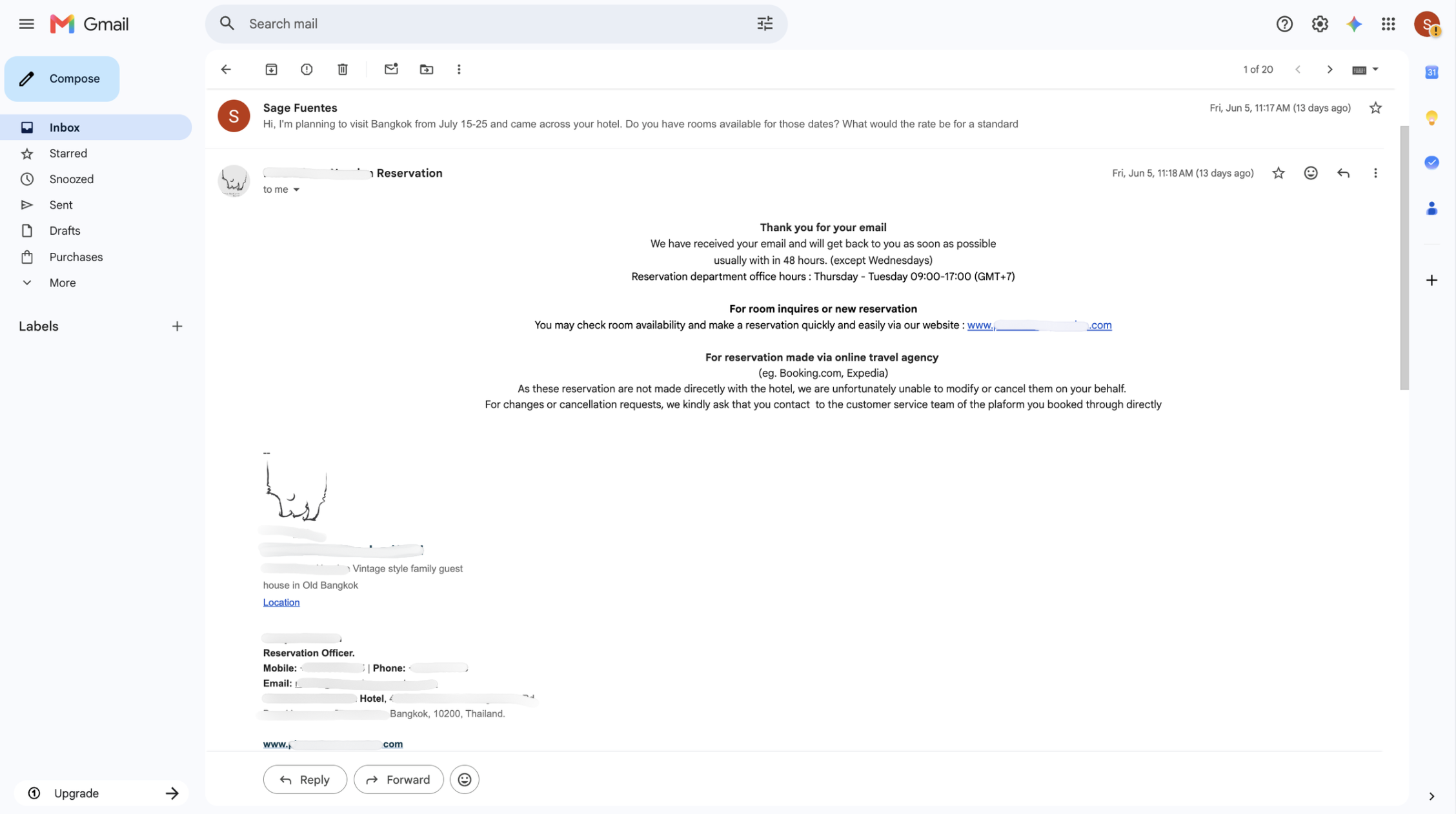
One hotel's auto-reply proudly informed me they'd respond within 48 hours. They replied five days later. I'm not sure who that timeline is for, but it isn't a guest trying to book a room this week.
A 4.8-star hotel's auto-reply promising 48 hours. The actual reply arrived 5 days later. Hotel name blurred.
Surprises
I expected hotels with higher review scores to respond faster. They didn't. One 4.8-star hotel — one of the best-rated in my entire test — was the one that promised 48 hours and delivered five days.
I expected LINE to crush email on speed, full stop. It was faster on average — but just as inconsistent. Baan Chart replied on LINE in 6 minutes flat, with a rate and a follow-up question about bed type — exactly what a good reservation conversation should look like. Other hotels on LINE took hours for the same kind of question.
Baan Chart's response on LINE, 6 minutes after the inquiry.
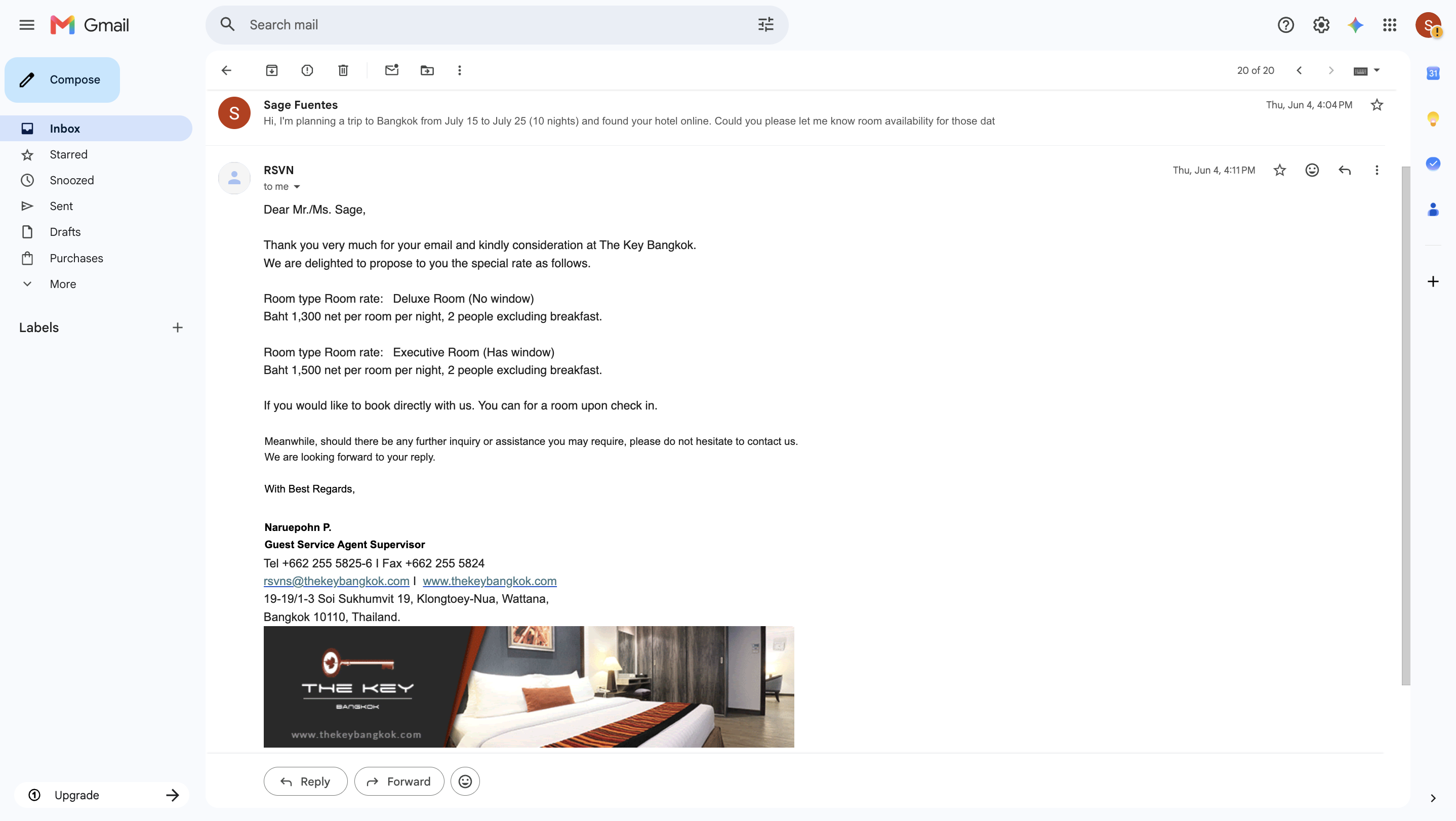
And some hotels just got it right, full stop. The Key Bangkok replied to my email in 7 minutes with two clear room options, rates, and an invitation to book directly — no fuss, no waiting. It's proof that fast, complete answers aren't some technical impossibility. Some hotels already do this well. The real question is why most don't.
The Key Bangkok's email response, 7 minutes after the inquiry.
At that point, I thought I had discovered a responsiveness problem.
A few weeks later, after walking into these hotels and speaking with staff, I realized I was looking at the wrong problem entirely.
I assumed guest communication belonged to the front desk.